It began on October 7, 2023 and over the past year, it has become increasingly clear that Israel has given up on its future. Peace has become a taboo subject, while the occupation has been transformed into an established reality, supported by the state and by a large part of the Israeli public.
Statements by the leaders of the main opposition parties, and the lists of candidates they have put forward, suggest that no fundamental change is likely after the elections. Those hoping for a return to political sanity are therefore left looking to the enlightened countries of the world. Sadly, even they are still treading carefully, fearful of taking a truly radical step.
Britain’s new Labour government, through Foreign Secretary, Ed Miliband, has acknowledged that ethnic cleansing is taking place in the occupied West Bank — a description that until recently was voiced mainly behind closed doors. The price will be a ban on imports from the settlements and sanctions against individuals responsible for terrorism originating in the settlements.
Britain, together with the countries supporting — and possibly joining — its measures, is punishing the settlers. But it is ignoring a fundamental reality: what is happening in the occupied territories is supported and financed by the State of Israel itself.
Whatever remained of the Green Line (1967 borders) was erased on October 7. “Where is the occupation?” ask the youths who occasionally turn up at Habima Square in Tel Aviv, where on weekend evenings we hold signs protesting the occupation and its consequences.
From the first demonstrations on Balfour Street in Jerusalem, and later on Kaplan Street in Tel Aviv during the struggle against the judicial overhaul, the protest movement chose to ignore the connection between Yariv Levin’s (Justice minister) political project and the occupation. Its leaders were unwilling to acknowledge that the judicial overhaul was also intended to entrench the occupation — and to exempt the ultra-Orthodox from military service.
The demonstrations became a struggle for democracy for Jews alone, while ignoring the obvious truth: there can be no democracy under occupation.
And now, as the elections approach, we see that three of the four major opposition parties prefer to ignore some 20 percent of the country’s citizens — its Arab voters and their elected representatives.
That is not representative democracy. And it certainly cannot be called democracy when, beyond the Green Line in the West Bank, that was never annexed by the “fully right-wing government”, an apartheid regime is being maintained.
Members of “Looking the Occupation in the Eyes” will continue to demonstrate. But our principal activity is elsewhere: as human-rights activists, and out of concern for Israel’s future, we maintain a protective presence among Palestinian communities in the occupied West Bank — communities subjected to a violent siege by settlers, the army and the police. (See the document below).
To support this work, we are launching a fundraising campaign to finance fences, gates, lighting and cameras — modest measures that can provide Palestinian residents of the occupied territories with at least some protection.
This week, three teenage members of the so-called “hilltop youth” were sentenced for an attack two years ago in which they beat Palestinian teachers and activists from “Looking the Occupation in the Eyes” at the Marja’ah school. The principal defendant was sentenced to six months in prison.
As the Jewish New Year approaches, it is permissible to hope that the direction in which Israel has been moving during the four years of Netanyahu’s government will change. It will not be a revolutionary transformation. But it could be a first step in the right direction.
Shana Tova.
Sunday
The High Court of Justice ordered the state and the IDF to coordinate, within 14 days, the return to their homes of the families of Mahmoud Tubassi Abbad and Wael Mahmoud Tubassi. The families were forced to leave their homes in Jalud on July 22 after months of harassment, siege and violence by settlers. After they left, settlers moved into their homes. Supreme Court President Isaac Amit and Justices Alex Stein and Yechiel Kasher sharply criticized the conduct of the army and police. The fact that the residents are still unable to return home, they ruled, “speaks for itself and cannot be accepted.”
Reports: Netanyahu ordered the evacuation of outposts in Area B following American pressure and concern over a possible escalation in the region. Sources familiar with the matter said that violent outposts are the focus of the enforcement effort. But the evacuations face a familiar problem: settlers return soon after the sites are cleared.
Two more young men were arrested in connection with the violent attack in Qusra. One is an 18-year-old serving in the IDF, from a settlement in the Jordan Valley. The other, 19, is from the Samaria region. An airsoft pistol, a knife, a pocketknife and tear gas were found in his vehicle.
In Khirbet al-Tawil, another fence was completed around a family home with the assistance of “Looking the Occupation in the Eyes.” The fence is intended to protect the family and its property from attacks by settlers from a nearby illegal outpost.
Monday
Haaretz reported that the IDF had warned the political leadership that it would have difficulty defending the settlements and newly established outposts in the northern West Bank because they lack basic security infrastructure. The army says the establishment of the outposts was reckless and driven not by security needs but by political considerations. The number of battalions in the West Bank serving under Central Command has reached a record 26 since October 7, 2023.
Omar al-Tubassi, a student from the village of Hajjah near Qalqilya, was shot dead overnight by settlers who raided a home in the village. When residents approached the settlers after they entered a house, the settlers opened fire.
A six-month prison sentence was imposed on a teenage settler who, together with two friends, entered the school of the Marja’at community in the Jordan Valley and beat teachers and activists from “Looking the Occupation in the Eyes” with clubs. The three minors stood trial before the Jerusalem Juvenile Court, and all three were convicted.
The attack took place on September 16, 2024, and was documented by an activist from “Looking the Occupation in the Eyes.” The footage showed the youths running amok, armed with clubs, beating Palestinians and human-rights activists in the schoolyard of a community that was uprooted from the area the following year as a result of settler violence.
In addition to the prison sentence, the principal defendant received a suspended sentence and was ordered to pay NIS 4,000 in compensation to an activist. A second defendant was sentenced to 300 hours of community service and ordered to pay NIS 750 to the activist and NIS 5,000 to a teacher at the school. The third was sentenced to 250 hours of community service and ordered to pay NIS 350 to the activist. A verdict has yet to be handed down in the case of Zohar Sabach, the owner of an outpost near the scene of the attack, who was charged with trespassing. A picture is worth a thousand words.
A young Israeli was stabbed by a Palestinian resident at the illegal outpost of Ma’oz Yehuda, near the village of Osarin in the Nablus area. The Israeli was taken to a Hospital. Soldiers shot and killed the Palestinian attacker. Palestinian reports said he had been receiving psychiatric treatment. Following the incident, the army closed the entrances to surrounding villages. In response, youths from a nearby outpost closed the entrance gate to Aqraba and attacked an activist who tried to intervene. Soldiers called to the scene allowed the gate to the town remain closed for several hours. Settlers also gathered near Palestinian communities, and the army deployed forces to prevent further violence.
Tuesday
International sanctions on the settlements
British Foreign Secretary Ed Miliband announced that, in response to war crimes in Gaza and settler terrorism in the West Bank, Britain would ban imports of settlement products, prohibit the sale to Israel of weapons that “contribute to the occupation,” and take action against those who assist or finance settlement construction. “We are declaring that the occupation of Palestine is illegal,” he said. The countries that announced that they would join the British sanctions are France, Canada, Poland, Denmark, Norway, Sweden, Iceland, Finland, Portugal, Spain and Ireland.
“Looking the Occupation in the Eyes” responded to the announcement by the countries planning to ban settlement products: “The countries of the world are witnessing what Israelis already know: the Israeli government has no interest in eliminating settler terrorism. They are also witnessing the shameful conduct of the army and police — standing by at best, and actively assisting at worst — in the face of pogroms and serious acts of violence committed by settlers.
“Against this backdrop, the decision to boycott settlement products is both predictable and proportionate. It joins what many Israelis and people around the world are already doing: boycotting products whose origins lie in the theft of land, homes and human lives.”
A 20-year-old settler from the Binyamin region was arrested on suspicion of involvement in the violent attack in Qusra. He is the fourth suspect arrested in connection with the incident. A vehicle allegedly used by the attackers was also seized.
Wednesday
The Binyamin Regional Council announced that the first permanent structures were arriving at the settlement of Mitzukei Eretz, near the Palestinian village of Marja’at. The village was abandoned by its residents several months ago after settlers established an outpost near their homes and subjected them to what has been described as ethnic cleansing.
The outpost, now receiving permanent structures, was recently legalized by Bezalel Smotrich, the minister responsible the Settlement Administration within the Defence ministry. The Binyamin Regional Council said the project was “the first settlement in decades to be officially legalized by the state along the Alon Road.”
The Lod District Court sentenced to 13 years in prison the settler who, in October 2018, killed Aisha al-Rabi, a 47-year-old Palestinian woman from the village of Bidya and mother of eight. He threw a stone at the car in which she was traveling with her husband near the settlement of Rehelim. The perpetrator was a minor at the time of the offense, and his name therefore may not be published.
Thursday
An indictment was filed against a 16-year-old boy who attacked and beat an elderly Palestinian man who had lost a leg in the southern Hebron Hills. The incident was filmed by the boy’s friend and subsequently viewed widely online. The defendant, a resident of the settlement of Abigail, was riding an all-terrain vehicle despite not having a driving licence. When he reached the Palestinian man’s home, he beat him with an iron bar.
Residents of Beita, near Nablus, reported that during the night IDF forces posted notices on their doors, bearing the Central Command emblem, ordering them to leave their homes for at least three days.
Activists from “Looking the Occupation in the Eyes” helped residents of Khirbet al-Tawil fill their household water tanks after settlers cut the community’s water pipe and the army prevented repairs.
Friday
The documentary “Naza”, directed by Yuval Abraham and Rachel Szor, won the Special Jury Prize at the 2026 Venice Film Festival. The film portrays an IDF system operating according to the premise that “there are no innocents in Gaza.” It is based on testimony from 24 intelligence officers, drone operators and soldiers who participated in the war. The screening ended with 25 consecutive minutes of applause. (Naza — “collateral damage,” an acronym in Hebrew.)
Three young men from Kh’alazoun were injured when their vehicle was attacked by settlers on a road near Marja’at. They were taken to a hospital in Jericho.
Saturday
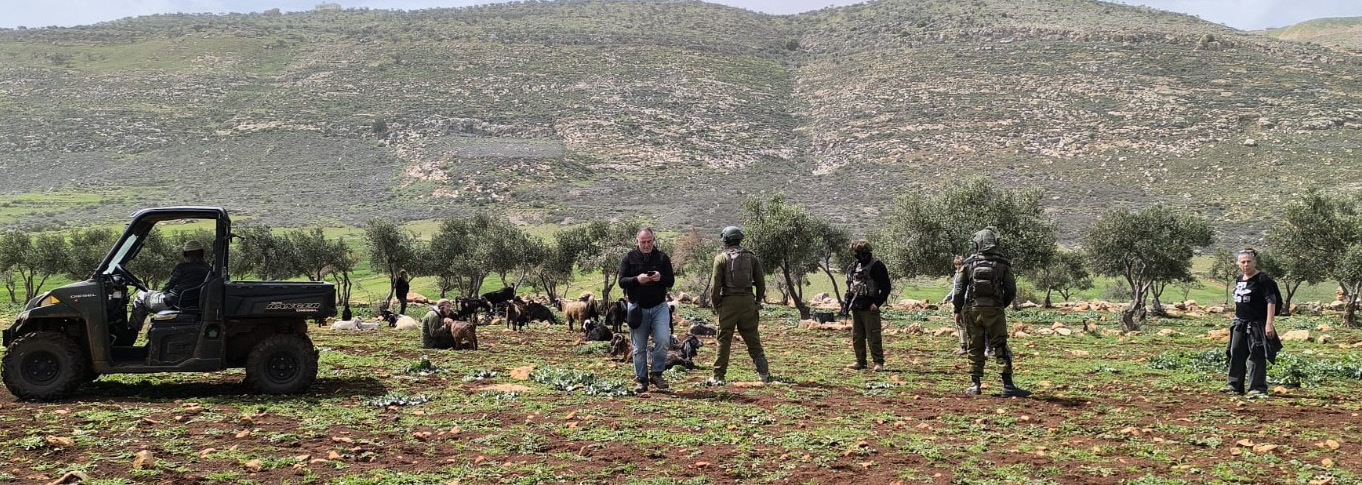
A soldier shot a Palestinian man in the leg on land belonging to the village of Faqqu’a in the Jenin area. According to the army, the force arrived after “friction” developed between residents and settlers over the village’s land. Shots were first fired into the air and then at the Palestinian resident.
In other words: a settler arrived with his flock in the Palestinians’ fields — apparently to harass them and provoke a confrontation. He then calls the IDF and reports an incident involving Palestinians. The army arrives, describes the situation as “friction,” and responds accordingly. Shots are fired. A Palestinian is hit and falls to the ground.
The entire incident took place on privately owned Palestinian land, where villagers had gathered to protect their property. The man who was shot was standing in a field, far from both the soldiers and the settlers, with his hands in his pockets. After the shooting, residents were detained for questioning. The settlers returned safely to their outpost.
The incident was filmed and posted online. Several hours later, the army issued a statement saying that “the findings of the initial investigation indicate that the soldier who fired in the Faqqu’a incident violated the rules of engagement.” A picture is worth a thousand words.
DOCUMENT
The Settlers Admit Their Guilt - There Is Jewish Terrorism
By Rachel Tzelnick-Abramovitz
Netanyahu, along with his ministers and Knesset members, should learn something from the settlers who are actually carrying out the violence.
The former insist on denying any connection to the October 7 massacre — though not to the monstrous killing and destruction in Gaza and Lebanon. In their version of events, everyone else is responsible: Rabin, Oslo accord and so on. Not them.
The latter, by contrast, do not merely refuse to deny the acts of terror they carry out in the West Bank. They boast about them. Below is a highly incomplete summary of their “achievements” during the Jewish year now ending. And remember the repeated claims that “there is no Jewish terrorism.”
A Year in the Struggle Against the Arab Enemy in the Holy Land — 5786
List of villages attacked and number of attacks:
Masafar Yatta (43), Mukhmas (25), Beita (21), al-Mughayyir (20), Zurif (17), Sa’ir (17), Qusra (15), Abu Falah (15), Jaba’ (14), Burqa, Ramallah (12), Turmus Ayya (11), Jalud (10), Salfit (10), Qaddum (10), Burin (10), Duma (9), Taybeh (8), Deir Jarir (8), Burqa, Nablus (8), Susya (8), Deir Sharaf (7), al-Dik (7), Hawara (7), Samu’ (7), Yabrud (6), Bethlehem (6), Aqraba (6), Hebron (6), Atara (5), Halhul (5), Deir Dibwan (5), Majdal (5), Beit Fajjar (5), Lubban ash-Sharqiya (5), Beit Furik (5), Beitillu (5), Ramon (5), Sebastia (5), Beit Lid (5), Jit (4), Beitin (4), al-Auja (4), Rasheidah (4), Sinjil (4), Umm al-Butum (4), Urif (4), Asira (4), Karyut (4), Deir Istiya (4), Silwad (4), al-Minya (4), Dahariya (4), Beit Umrin (4), Beit Ummar (4), Osarin (4), Abu Najim (4), Ein Sinya (3), Yasuf (3), Kisan (3), Nablus (3), Malik (3), al-Lubban (3), Qabalan (3), Umm Safa (3), Jurish (3), Za’tara (3), Jaljulia (3), Madama (3), Idhna (3), Yatma (3), Deir Abu Mash’al (3), Nahalin (3), Ein Samiya (3), Shuqba (3), Bardala (2), Ra’i (2), Funduq (2), Qalqilya (2), Tammun (2), Jaljulia (2), Ramin (2), Talfit (2), Birzeit (2), Far’ata (2), al-Matwi (2), Raba (2), Ramallah (2), Awarta (2), Ein Yabrud (2), Funduqomiya (2), Deir Ammar (2), Bidya (2), Zur Baher (2), al-Tawani (2), Tal (2), Haris (2), al-Zuweidin (2), Tayasir (2), Mu’arrajat (2), Qarawat Bani Hassan (2), Bazariya (2), Rantis, Khirbet al-Hadidiya, Wadi Said, Jabraya, Ein al-Qasab, al-Jaba’, al-Fuqa, al-Hadrah, al-Jib, Beit Zaidan, Tuqu’, Marah Rabah, Umm al-Hayek, Beit Duk, al-Shuyukh, Deir Ballut, Bil’in, Khirbet Bazik, Ein Rafa, Tarqumiyah, Aqabat Jaber, Ras al-Ain, Imatin, Rafat, Jibiya, Mazra’a al-Nubani, Beit Anan, Saffa, Kur, Umm Tuba, Laqif, Yasid, Jamma’in, Khirbet Saud, Afqis, Deir Shams, Rujeib, Awarta, Ein Karem, Khan al-Ahmar, Jamma’in, Aqabat Hasaka, Marda, Deir al-Hatib, Salit al-Dahr, Ya’bad, Salem, Deir Amer, Ein Shabab, Khirbet al-Markaz, Tarouja, Khalil al-Louz, Khirbet al-Tiran, Bani Na’im, Silwan, al-Arroub, Ein Ayoub.
Vehicles burned: 436
Buildings set on fire: 201
Mosques set on fire: 15
Arabs injured: 409
In addition, tens of thousands of windows were smashed, thousands of olive trees were cut down, hundreds of tires were punctured, and tens of thousands of dunams of fields and orchards were set ablaze.
Source: ANash News