
This week, attacks and harassment targeting the olive harvest continued throughout the West Bank, with the active or passive complicity of uniformed personnel. Palestinians and human rights activists were assaulted across the territory. The injuries sustained by diplomats from Poland, France and Belgium in Taybeh, together with the serious injuries suffered by a Washington Post photographer in the village of Abu Falah, brought the phenomenon to international attention. Journalist Heidi Levine told her interviewers: “None of the attackers will be brought to justice.” Prime Minister Benjamin Netanyahu’s office responded: “Serious allegations require serious evidence,” describing the reports as “a coordinated campaign to defame Israel, relying on sensational headlines.”
Figures published by the Israeli human rights organization Yesh Din recorded 377 incidents of settler and soldier violence in 162 Palestinian communities across the West Bank between September 27 and October 10, an average of approximately 27 incidents a day. According to the organization, 174 incidents were directly related to the olive harvest. These included 58 assaults involving physical violence against harvesters, 57 cases in which settlers or soldiers prevented harvesting, 100 incidents of crop theft, and 34 cases of damage to or destruction of olive trees. Soldiers were documented as being present in at least 44 of the incidents related to the harvest.
On the political front, with elections scheduled for next week, two revelations stood out. In a country governed by normal standards of accountability, either would have sent shock waves through the political system, prompted the prime minister to resign and significantly affected voting intentions. The first was an interview given by Maj. Gen. (res.) Avi Gil, who served as the prime minister’s military secretary on October 7. The second, more detailed revelation was a three-million-shekel defamation lawsuit filed by Ronen Bar, head of the Shin Bet on October 7, against Netanyahu. Resignation? Not in Israel.
Ronen Bar’s statement of claim describes dozens of occasions on which the Shin Bet chief conveyed assessments, warnings and recommendations concerning Hamas, all of which the prime minister rejected in order to keep his government in power. Netanyahu and his spokespeople are now working to obscure what happened—and what continues to happen—by spreading lies. Their aim is to ensure that voters who supported him in previous elections ignore the damage inflicted on the country over the past four years by the hard-right government.
The opposition parties’ attempt to win right-wing voters—three of the four opposition parties are themselves right-wing—plays directly into Netanyahu’s hands. The only card he has put on the table that has worked to his advantage is the attempt to draw a dividing line between the “Zionist parties” and the Arab parties. Gadi Eisenkot, Naftali Bennett and Avigdor Lieberman have taken the bait. If they want to form a government, they will have to swallow their pride and reverse their position. Still, every cloud has a silver lining: this grim reality may encourage Arab voters to turn out in greater numbers.
Over the past two weeks, approximately 3,200 donors contributed one million shekels to the fence-building campaign launched by Looking the Occupation in the Eye. The campaign is intended to help install protective infrastructure around the homes of Palestinian families targeted by settlers in the West Bank. The scale of the public response surprised us and demonstrates that our efforts will not be in vain. Fences, iron gates, cameras and lighting cannot, by themselves, put an end to settler violence. But they can provide families with meaningful physical protection, make the difference between a family forced to flee its home in terror and one able to remain there, and help resist settlers’ attempts to take control of the land. We can already report that the system needed to identify families in need and arrange protective measures for their homes is now in place.
Sunday – Police announced the arrest of two suspects as part of a joint investigation with the Shin Bet and military police into “extremist violence in the area of Aqraba approximately one month ago.” Settlers reported that one of the suspects was the security coordinator of a settlement in the area. Last week, settlers opened fire on Palestinian olive harvesters near Aqraba.
Settlers continued harassing olive harvesters throughout the West Bank. Palestinians reported a series of attacks, including the siege of family homes in Umm al-Khair in the southern Hebron Hills, the theft of crops in Yabrud and other villages, and assaults on Palestinians and damage to agricultural structures.
A settler was filmed poisoning a goat from his own herd near al-Mughayyir. Settlement activist and influencer Elisha Yered claimed: “Terrorists from al-Mughayyir poisoned goats.” This was not the first time settlers had staged a provocation that could then supposedly be used to justify an attack on a Palestinian shepherding community.
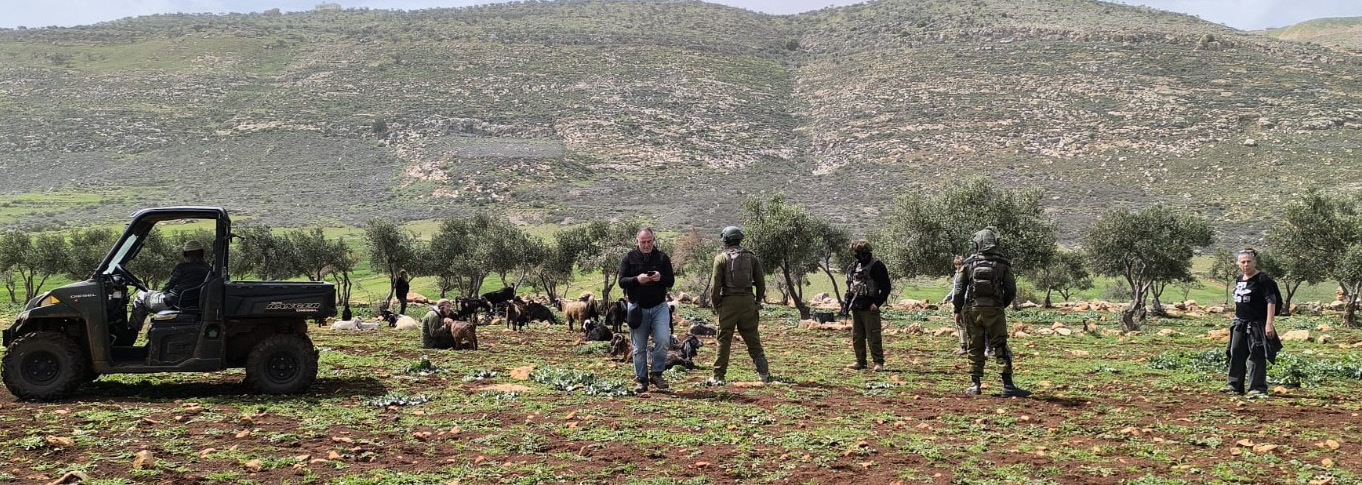
Monday – Brig. Gen. (res.) Yoel Feldschuh was arrested by officers from the Judea and Samaria District of the Israel Police. Feldschuh, a former head of the Israeli Air Force Intelligence Directorate and a fighter pilot, had joined olive harvesting on land belonging to the village of Duma in the Binyamin region, together with activists from Looking the Occupation in the Eye and Israeli and foreign journalists.
Video footage shows a young settler harassing two Palestinian women carrying sacks of harvested olives. Feldschuh and others intervened and moved him away from the harvesters. The settler left the scene and called the army and police. The uniformed personnel subsequently decided to arrest Feldschuh and an activist from Looking the Occupation in the Eye.
“The police questioned only the settlers. No one asked us what had happened,” said Maj. Gen. (res.) Eyal Ben-Reuven, a member of Commanders for Israel’s Security who actively supports protective presence in Palestinian communities. Feldschuh and the activist were released at the Binyamin police station.
Settlers attacked a Palestinian family in their home. According to a Palestinian report, the assailants posed as soldiers conducting an operational mission in the village of Talfit, in the Nablus district. Three family members were injured and required medical treatment. According to the account, five settlers knocked on the door and identified themselves as soldiers. When the door was opened, they beat the parents and their daughter.
Tuesday – Settlement security coordinators and members of settlement emergency response squads in the northern West Bank staged a series of protest actions. At Za’atra (Tapuah) Junction, they blocked the roundabout with their official service vehicles; they also blocked Route 5 in the West Bank. They were protesting the arrest of a settlement security coordinator and another settler suspected of involvement in a terrorist attack near Aqraba two weeks earlier, when two settlers allegedly opened fire on Palestinian olive harvesters.
Police announced the arrest of a settler in his twenties on suspicion of assaulting a Palestinian driver in Yabrud, in the Ramallah district, on Friday. The driver fled, and the settlers took his vehicle. Police found an airsoft pistol, a knife, pepper spray, a drone, three slingshots, a face covering and military equipment suspected of being stolen in the suspect’s car.
At midday, settlers entered Abu Falah, south of the southern Hebron Hills. Several residents of the targeted village were arrested by the army.
Al Jazeera and Palestinian media reported that Israeli forces raided the offices of Addameer, a prisoners’ rights organization, and the Union of Palestinian Women’s Committees in Ramallah. Troops also entered the grounds of Palestine Medical Complex, the largest medical center in the West Bank. According to the Palestinian news agency WAFA, at least two Palestinians were wounded by Israeli army fire.
Settlers set fire to a mosque, a vehicle and an olive tree in the town of Mukhmas, northeast of Jerusalem. Graffiti sprayed on the walls of the burned mosque included the phrases: “Just because we are quiet does not mean we are asleep,” “We haven’t gone anywhere,” “Evacuations = chaos,” and “Greetings from Susya.” Palestinians holding American citizenship live in the town and own homes there. Recently, the local council announced that a civil lawsuit would be filed in the United States on behalf of residents harmed by settlers who, like some of the alleged perpetrators, also hold American citizenship.
Two Palestinian olive harvesters were injured in an attack by settlers in Beita, in the Nablus district.
Wednesday – A minor from the Jackson outpost group sprayed activists from Looking the Occupation in the Eye with pepper spray in Khirbet a-Tawil.
Thursday – A Palestinian olive harvester was injured in a settler attack while harvesting olives in the village of Burqa. He was beaten with clubs and pelted with stones before being taken to hospital with head injuries. The victim holds American citizenship.
A group of activists from Looking the Occupation in the Eye, taking part in a peaceful demonstration in Habima Square in Tel Aviv that evening, were attacked by a gang of Kahanist and pro-Netanyahu extremists led by Mordechai David. A few passersby intervened and tried to separate the attackers from their victims. Police arrived within minutes, and David was the first to disappear from the scene.
Friday – A resident of Beit Ummar, north of Hebron, was wounded by settler gunfire overnight. Settlers had fired toward homes in the town and subsequently shot at Palestinian residents who came out to confront them.
Heidi Levine, 63, a Washington Post journalist, was injured in a settler attack while covering the olive harvest in Abu Falah, north of Ramallah. Levine underwent surgery on her hand. She said: “I was attacked and shoved to the ground. Fortunately, I was wearing my protective vest and a helmet. Otherwise, I probably wouldn’t be here at all, because they just kept kicking me over and over—about 50 times.”
Uniformed personnel arrived at the scene but used riot-control measures against the Palestinians instead of stopping the settlers’ assault. The attackers continued their violence despite the presence of the army and Border Police. President Isaac Herzog spoke with Levine and was reported to have “strongly condemned this appalling phenomenon of violence.” The US ambassador said that anyone who attacked an unarmed journalist should spend many years in prison.
Settlers attacked olive harvesters in Turmus Ayya, in the Ramallah district, and set vehicles on fire. Another assault was reported in Burin.
In response to rabbis from Gush Etzion who had spoken out against the violence of hilltop youth and the theft of olives during the harvest, Dov Lior, a rabbi associated with the Otzma Yehudit party, ruled that the appropriation of the olives was permissible under religious law and even described it as a mitzvah, or religious commandment.
Saturday – A delegation of diplomats and public figures from Poland, Belgium and France was attacked by settlers during a visit to the Christian town of Taybeh in the Ramallah district. Masked settlers carrying clubs were filmed attacking a vehicle occupied by members of the delegation. It was subsequently reported that the settlers smashed the window of the Belgian consulate’s diplomatic vehicle.
One of those injured was Bernard Baudoux, mayor of Aulnoye-Aymeries in northern France. According to his account, the settlers knocked him to the ground, kicked him and beat him with metal bars.
It was also reported that the Israeli army had ignored warnings from a human rights activist who called the military operations room to alert it to the settler attack in the town. The army later responded that the visit had not been coordinated with it.
The foreign ministers of the countries whose representatives were attacked condemned the assaults. In a statement, Poland’s Foreign Ministry said: “We expect the Israeli authorities to provide urgent and detailed explanations, identify those responsible and ensure that they are held accountable for their actions.”
Belgium’s foreign minister said: “We will continue to press for European Union sanctions against those responsible for this violence and those who support them. As the occupying power, the Israeli authorities are obliged to protect Palestinians. The impunity enjoyed by violent settlers must end.”
After several days of harvesting olives and taking the crop to an olive press in Aqraba, an army unit entered the premises, threw stun grenades, and the olive press was set on fire.
Khirbet a-Tawil: Harassment by the young members of the Jackson outpost group, associated with the settler Jackson himself, continued the habitants at several locations in the village. The intruders attempted—and in some cases succeeded—in entering residents’ homes and residential compounds despite the protective presence of Looking the Occupation in the Eye activists. The youths stepped on solar water heaters, tried to open water taps and assaulted activists. One minor snatched a phone from a female activist and fled with it to the outpost. Activists who went to the outpost to demand the phone’s return were attacked with pepper spray, and their vehicle was blocked.
Soldiers harassed olive harvesters in Beit Furik, dumping the olives they had collected and detaining the harvesters. In Deir Jarir, north of Ramallah, masked men threw stones at harvesters, who responded by throwing stones themselves. The Israeli army issued the following statement: “Following a report of stones being thrown at an Israeli civilian and a confrontation in the area, in which the civilian was injured and evacuated for medical treatment, the forces arrived and acted to disperse the confrontation.”