Israeli citizens turned out in large numbers to vote. Fifty-eight percent chose change, seeking to extricate their country from the grip of the corrupt October 7 government, prevent the continuation of the endless war, and halt Netanyahu’s campaign to destroy democracy and turn Israel into an apartheid dictatorship.
However, the election results — in which the two Arab parties won 19 seats — failed to provide, as is customary in democracies around the world, a clear answer to the question of what kind of government Israel will have. The leaders of the Change bloc, whose parties won a combined 48 seats, now face an apparent dilemma. Netanyahu, with 53 seats in the right-wing bloc, cannot form a government. But neither can Eisenkot, Bennett and Lieberman, at least as long as they stick to their pre-election declarations. Nevertheless, they have one advantage: Netanyahu has no alternative, whereas the Change bloc does — but pursuing it would require breaking promises made to voters.
The fact that Arab voters flocked to the polls and brought their turnout rate up to that of Jewish voters demonstrates that something fundamental has changed in Israel. Ignoring the election results, and the fact that all 120 members of the Knesset have equal status, would prevent the realization of what most voters want: change. One further question deserves consideration by voters and their elected representatives in the Change bloc: Would Netanyahu have hesitated to break promises made before the election?
Previously we warned that this would happen: Likud would try to undermine the election results. Indeed, it began doing so on election day itself. The conduct of the Shin Bet (Israel Security Agency) is puzzling. Just days before the election, its director declared that the elections were secure and fair. At the same time, the agency possessed certain information concerning Qatar which, apparently, it did not consider sufficiently serious to warrant opening an investigation or taking action to prevent the alleged scheme before election day. It acted only afterward.
The implication is that this is an attempt to cast doubt on the legitimacy of the election results and prevent the possibility of cooperation with the Arab parties Hadash-Ta'al and Ra'am in immediate moves by the 67 MKs to replace the Knesset Speaker, advance urgent legislation and, subsequently, form a government.
Netanyahu's Likud is seeking to delegitimize Arab citizens in order to intimidate the Change bloc and deter it from cooperating with the parties that represent them. The response being promoted by Likud is the idea of "national unity", and it appears to be receiving a favorable response. Voters who supported Eisenkot and Bennett are prepared to let Netanyahu, leader of the largest party, remain prime minister or, at the very least, serve as a minister after President Herzog grants him a pardon. They are willing to accept this simply to avoid another government with Smotrich and Ben-Gvir and to avoid another election campaign, whose outcome could well be less favorable.
According to this line of thinking, Likud, Yashar (Eisenkot) and Yahad (Bennett) would form a bloc of 60 seats, and it would not be difficult for them to bring a Haredi party on board.
Such a move would contradict and distort the election results. More seriously, it would disregard Arab citizens, who constitute 21% of Israel's population and are willing and eager to participate in shaping the country's future. This is an opportunity that may never return: an opportunity to establish a genuine civic partnership and make possible a shared life based on equality, as promised in the Declaration of Independence.
The political leadership of the Change bloc has failed to offer an alternative vision to the right's landscape of fire, clouds of smoke and racism. Its spokespeople have ignored the Israeli-Palestinian conflict. The election results show that the public, too, chose to ignore the most significant problem facing Israel — the very issue that holds the key to securing the country's future as a safe and prosperous state. The Democrats' eight seats — despite their own avoidance of the word "occupation" — make this clear.
In the face of this blindness, Arab voters chose to demonstrate that they want a country committed to peace. Now it is the Change bloc's turn to stand up to the poison machine, which will not stop and is likely to intensify its campaign. Eisenkot's test will be whether he can persuade his political partners to accept his leadership and build mechanisms for cooperation with representatives of Arab society.
Eisenkot offered his voters no vision. He relied solely on the public's desire for change. But now that he has been given a mandate, he must decide whether to lead the country in a new direction or continue along the path laid out by Netanyahu. There will be no second opportunity.
Sunday – Masked settlers raided an olive grove where harvesting was underway in the village of Immatin, east of Qalqilya. They stole tractors and rolled them downhill, causing them to crash.
Settlers stole sheep from a Palestinian flock in the southern Hebron Hills. In a separate incident, settlers reportedly pelted Palestinian vehicles with stones during the night in the village of Sinjil.
Monday – A UN independent commission of inquiry determined for the first time that Israel had committed "crimes against humanity" in the West Bank, including torture and rape, alongside additional allegations of war crimes in both the West Bank and the Gaza Strip.
According to the Palestinian news agency WAFA, the Hebron municipality announced that more than 3,150 residents had been displaced from their homes, while hundreds more were trapped inside their houses, unable to leave, as Israeli forces operated in the city.
The High Court of Justice held another hearing on a petition filed in March 2025 by the Bedouin shepherding community of Ras Ein al-Auja, numbering approximately 1,100 people. The community had abandoned its village following violence and harassment by residents of illegal outposts.
The state, the respondent in the case, acknowledged its legal obligation to protect the area's residents but argued that operational difficulties prevented it from assigning a permanent security force to the location.
The justices noted that ensuring citizens' ability to live safely in their homes is the "A-B-C of public order." They also made clear that the fact that approximately nine months had passed without the community being able to return home constituted "a situation that requires remedy."
The court issued an order requiring the state to explain, by December 1, 2026, why it should not take the following measures:
- Immediate return: Ensure that community members can return to their homes as soon as possible.
- Restricting the movement of attackers: Issue a closed military zone order prohibiting Israeli civilians from entering the community's residential area without coordination with its residents.
- Enforcement against illegal construction and evacuation: Remove illegal outposts established within the village's living area and demolish or block an unauthorized road that has been paved there.
- A concrete security plan: Present practical measures to guarantee the community's safety in both the short term, during its return, and the long term.
Tuesday – Election Day – Soldiers detained two Palestinian olive harvesters in the village of Huwara in the southern Hebron Hills after the two had been attacked by settlers and sprayed with pepper spray. Footage published from the incident shows a soldier beating a Palestinian man who was kneeling, blindfolded and with his hands tied.
A 50-year-old Palestinian man was injured in a settler attack on olive harvesters in the village of Deir Jarir, northeast of Ramallah.
Near the town of Beit Ur al-Tahta, southwest of Ramallah, settlers harassed Palestinian farmers harvesting olives on their own land. Soldiers present at the scene did not intervene.
In the early hours of the morning, settlers attacked the village of Umm Safa in the Ramallah area, set several vehicles on fire and sprayed nationalist slogans on walls.
Uniformed personnel fired at a Palestinian vehicle during a raid on the village of Nabi Saleh, north of Ramallah.
Dozens of residents were detained during an army raid on the village of Burin.
Security forces demolished monuments in several villages, including one that MK Zvi Sukkot had been filmed attempting to destroy.
Wednesday – After six days, the siege imposed on residents of Masafer Yatta and Umm al-Khair was lifted. The local battalion commander opened the gate.
According to OCHA, approximately 1,200 Palestinians live in 13 communities in Masafer Yatta, south of Hebron. Residents had been prevented from receiving supplies of water, food and medicine. Their livestock were also left without water or fodder. Children could not attend school, while human rights activists and members of the media were kept away.
The Jerusalem Magistrate's Court overturned the ban imposed on volunteers from "Rabbis for Human Rights" preventing them from entering the West Bank. The court ruled that there had been no reasonable suspicion that they had broken the law.
The appeal argued that the private land where the olive harvest was taking place in the village of Nahalin did not require prior coordination with the army, and that maps issued by the Civil Administration confirmed this.
Thursday – Settlers attacked human rights activists, both women and men, in Umm al-Khair in Masafer Yatta. They sprayed pepper spray into their eyes and beat them. Two activists were injured, including Andrei Khrzhanovsky.
An ambulance arrived, but settlers blocked its path and prevented it from leaving. Andrei was taken to the Kiryat Arba police station and charged with obstructing a police officer in the performance of his duties, assault causing actual bodily harm, using force to prevent an arrest, making threats, insulting a public servant, violating a legal order and entering a closed military zone.
The High Court published its decision concerning a petition filed by three families from Jalud who had been driven from their homes by violent settlers. The justices sharply criticized the state's failure to enable the families to return home. The state was ordered to pay the petitioners NIS 51,000 in legal costs, allow professionals to enter the burned homes to carry out restoration work, and announce by November 10 how it would ensure the families' safe return.
Friday – The number of incidents of harassment of Palestinian farmers by settlers and Israeli uniformed personnel across the West Bank today reached 22. This was reported by the Palestinian news agency WAFA.
An IDF force entered the village of Kafr Malik, northeast of Ramallah, and declared it a closed military zone. This followed settler attacks on olive harvesters and the firing of tear-gas grenades by soldiers at residents. A foreign human rights activist and five residents were arrested.
In the southern Hebron Hills settlers set fire to a Palestinian agricultural structure. In Bruqin, settlers attacked olive harvesters and forced them to leave their land. One of the harvesters was taken to hospital. The settlers also reportedly damaged the farmers' vehicles. In Jaba', south of Jenin, settlers stole and vandalized agricultural equipment.
Saturday – Thousands of demonstrators took part in an evening protest in Tel Aviv's Habima Square. They called for the formation of a change government that would reflect the election results and include cooperation with Hadash-Ta'al and Ra'am. An hour later, the demonstrators marched to Rabin Square, leaving Habima Square to a few hundred right-wing protesters. Demonstrations in support of a change government were also held in other cities.
A Palestinian man injured in an attack by settlers from the "Giborei David" outpost near Duma, south of Nablus, was taken for police questioning while still wounded, after an army force had prevented medical teams from reaching him for several hours. One of the other victims of the attack received treatment from a settler paramedic.
"Soldiers halted the olive harvest of Palestinian farmers in the southern Hebron Hills after asking an armed settler whether they should do so. They then ordered activists to leave behind the olives they had picked," wrote Matan Golan in Haaretz.
The Palestinian news agency WAFA published a report on the olive harvest yield in the West Bank this season, against the backdrop of restrictions on access to groves and settler attacks. The Palestinian Ministry of Agriculture has cut its estimate of the annual olive sector yield by approximately half, to 10,000–11,000 tons instead of the projected 21,000 tons. Damage to the olive industry caused by the destruction of trees and the prevention of access for harvesters has amounted to approximately $157 million since 2023.
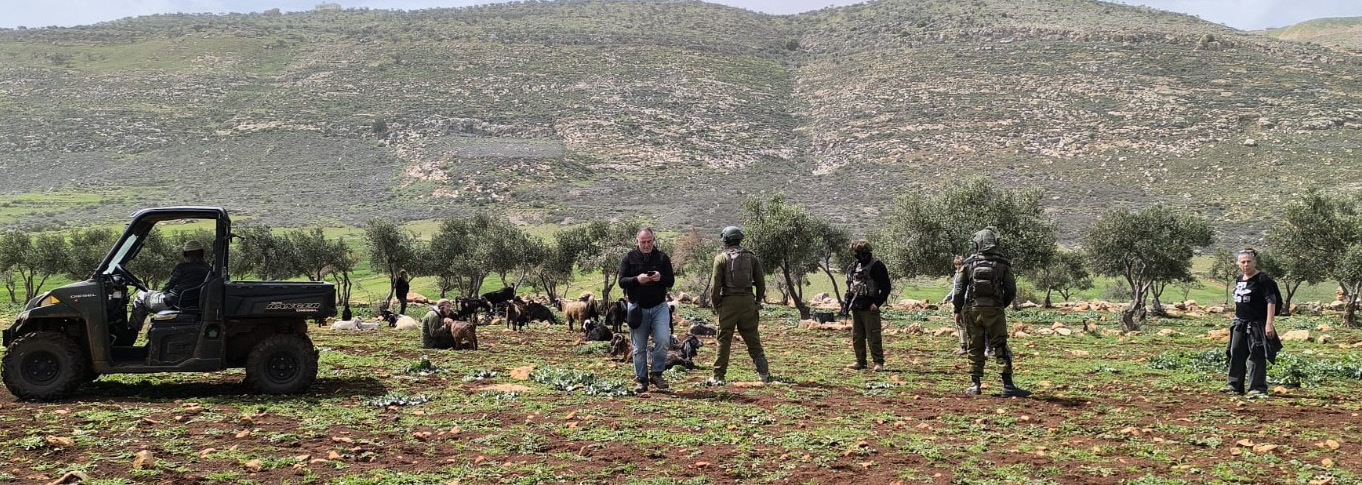
Khirbet a-Tawil – This week was marked by incursions by settlers from the nearby outpost, including minors and young adults, aimed at preventing community members from grazing their livestock. The settlers also sought to intimidate residents and engaged in nighttime prowling intended to harass human rights activists maintaining a protective presence in the area.
The security coordinator of the "Givot Olam" outpost, south of Itamar, detained Looking the Occupation in the Eye activists without any justification and directed derogatory remarks and threats at them. Police and the army arrived at the scene. Following an inquiry, the activists were allowed to continue on their way.