On Tuesday, settlers arriving in all-terrain vehicles drove to olive groves north of the town of Aqraba and opened fire on Palestinians harvesting olives. Several pickers were wounded. An Israeli army unit rushed to the scene, evacuated the wounded and ordered the residents to leave the grove, citing a military closure order.
No Israeli or international activists were present when the shooting occurred. Such activists sometimes accompany Palestinian olive pickers to protect them from attacks by settlers. Activists from Looking the Occupation in the Eye, who maintain a continuous protective presence in nearby Khirbet a-Tawil, arrived after the shooting.
According to the commander of the army unit, it was the Palestinian olive pickers who had attacked the settlers. This happened in a Palestinian-owned olive grove that the settlers had traveled a considerable distance to reach, intent on disrupting the harvest at the very start of the season.
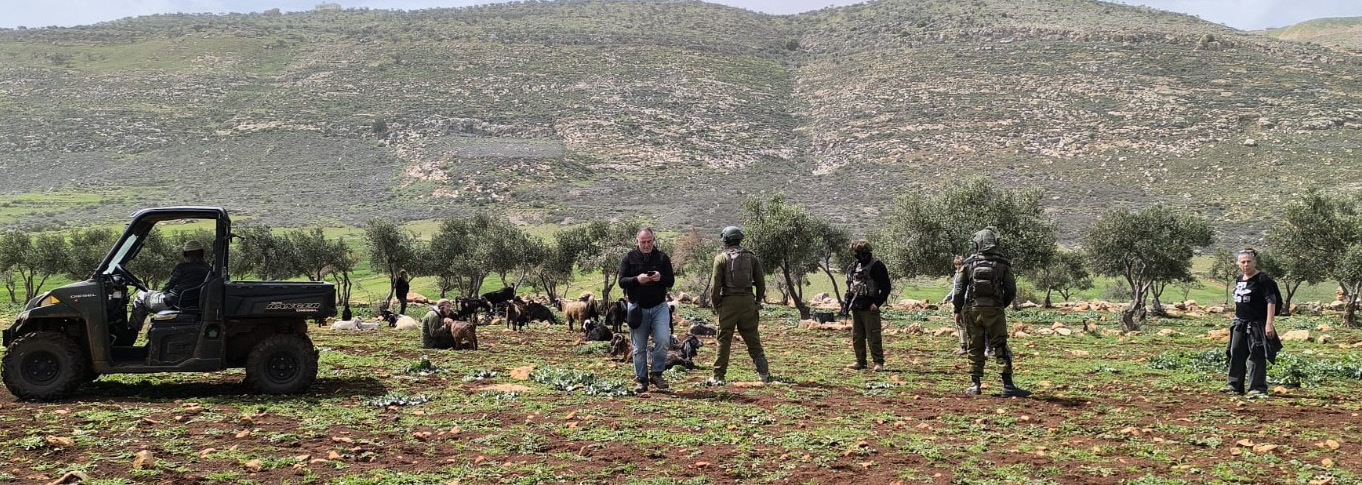
Such incidents are routine in the West Bank. Settlers invade, threaten and attack Palestinians, then complain that they have been attacked themselves. The army, which long ago became a rubber stamp for the reality settlers impose in the West Bank, is only too willing to swallow this story. The response follows quickly: an order declaring the area a closed military zone, preventing the harvest from continuing.
On Tuesday, Matan Golan and Jacky Khoury reported in Haaretz that, according to sources in the local Palestinian administration, Israel's District Coordination and Liaison Office had warned orchard owners not to bring volunteer escorts, whether Israeli or foreign. It reportedly threatened to cancel all coordinated harvests in the area if they did so.
Late last week, Israeli activists arrived to help with the olive harvest in the village of Beita. Video footage shows an army unit and an armed settler arriving with an order declaring the area a closed military zone. In the footage, a soldier tells a Palestinian: “You are not allowed to harvest until all the Jewish anarchists leave here.” According to Haaretz, this was the third time soldiers had prevented an olive harvest attended by Israeli activists.
The incidents in Aqraba and Beita show that the outcome is the same whether or not volunteer activists accompany the Palestinians. The objective is to make Palestinian life more difficult by every possible means, as part of a policy of ethnic cleansing. The army and the settlers work hand in hand to undermine residents' ability to earn a living, at a time when agriculture has become a significant source of income since Israel revoked, after October 7, the vast majority of work permits previously granted to West Bank Palestinians employed in Israel.
The army is helping implement a policy of expulsion, in direct violation of its obligations under international law as the occupying power to protect the residents of the occupied territory. In practice, however, the army and the settlers are coordinated and determined to make Palestinian life unbearable.
Less than three weeks before the elections, the Netanyahu government is leaving its successor more than 100 illegal farms, in addition to outposts and a network of terror supported directly and indirectly by regional councils and government ministries. Together, they are working to push Palestinians out of Areas B and C and prevent any possibility of establishing an independent Palestinian entity. Meanwhile, the leaders of the opposing camp, who aspire to form a “Change Government 2,” appear likely to continue the same policies pursued by the first “Change Government.”
Palestinians are awaiting the election results in the hope that Israeli policy will change. Continued annexation and the denial of any political horizon will intensify international pressure on Israel. At the same time, the possibility of another intifada in the West Bank cannot be dismissed. Despite the current signs, one can only hope that a change-oriented government will emerge—one that understands that the conflict with the Palestinian people cannot be separated from the state of liberal democracy in Israel, and that will not shy away from confronting the fundamental questions surrounding the occupation.
The Israeli human rights organization Yesh Din reported 109 incidents of violence in 75 Palestinian villages and communities over a ten-day period, involving settlers and soldiers and directly connected to the olive harvest. In Khirbet a-Tawil, where activists from Looking the Occupation in the Eye maintain a protective presence, settlers were observed invading residents' olive groves throughout the week, and incidents of olive theft were documented.
Sunday – Raafat Abu Shams, a 41-year-old officer in the Palestinian Authority, died after being detained at an Israeli army checkpoint in Tulkarm. According to reports, he was beaten to death. The IDF said he had suffered cardiac arrest.
Israeli troops entered Birzeit University's campus near Ramallah and used a bulldozer to destroy a “memorial to the martyrs of Birzeit University.” The list of names commemorated at the site included Islamic Jihad founder Fathi Shaqaqi, Yahya Ayyash, known as “the Engineer,” and others described as “martyrs.” Members of the university's security staff were arrested.
Monday – Soldiers opened fire on a car that accelerated toward them near the town of Bani Na'im, north of Hebron. According to the IDF spokesperson's statement, the soldiers had ordered the driver to stop, but he failed to do so and struck an Israeli military vehicle. Three adult Palestinian laborers were in the car. Two passengers were killed and another was moderately wounded.
Settlers blocked the road between the villages of Ramon and Deir Dibwan. A Palestinian vehicle was set on fire, and one of its occupants was critically wounded and later died of his injuries. Police and the army reported that Israelis had neutralized a Palestinian in the vehicle who was carrying a knife.
Cars and olive trees were set ablaze in an arson attack by settlers in the village of Ein Yabrud, north of Ramallah.
Settlers raided the Bedouin community of Mu'arrajat Jaba, north of Jerusalem near the settlement of Adam, and set homes on fire. Uniformed personnel who arrived at the scene fired stun grenades at residents and detained Palestinians and Israeli activists, alleging that they had violated a closed military zone order. Several Palestinians were wounded and taken for medical treatment.
Tuesday – Matan Golan and Jacky Khoury reported in Haaretz that Palestinians in the West Bank had been informed that Israel was working to prevent volunteers from accompanying them during the olive harvest and would close any groves where such volunteers were present.
Settlers launched an attack on the outskirts of Aqraba, firing live ammunition. They had come to prevent the olive harvest and succeeded in driving the Palestinians away. Journalist Jaafar Ashtiyeh, who was documenting the events, was wounded. The army declared the area a closed military zone and prevented activists from Looking the Occupation in the Eye, who were in Khirbet a-Tawil, from reaching the scene.
Daniel De-Malach, who was there, reported in a post: “An emergency response squad from Itamar attacked Palestinian olive pickers with live fire on Tuesday, many kilometers from their settlement. The regular army, which arrived at the scene, completed the job and drove them off their land. Two arms of the IDF working in close cooperation—a collaboration I witnessed with my own eyes...
“IDF soldiers arrived at the site and, instead of arresting the attackers, detained the Palestinians who had been shot. We later watched them in action. They completed the expulsion of the Palestinians from their land and brazenly prevented the harvest, shouting that they were acting under a ‘closed military zone order’ they had issued. They barred us from entering as well. While masked soldiers allowed the shooters to leave the area bareheaded in unmarked all-terrain vehicles...
“As outrageous as the events themselves was the IDF spokesperson's false account of what happened. It described how our army forces restored order after ‘two members of a settlement security team entered the area adjacent to the settlement of Itamar’ in the Samaria Brigade sector, ‘after identifying Palestinians near the settlement’...”
In the early morning hours, Jerusalem municipal bulldozers demolished a five-story residential building in the East Jerusalem neighborhood of al-Tur. The building's 70 residents, most of them women and children, were forcibly evacuated and prevented from removing their belongings. National Security Minister Itamar Ben-Gvir was seen at the scene supervising the demolition of the building, which had been constructed without a permit. Such permits are lacking because the authorities rarely approve Palestinian building plans.
Wednesday – Ali Hassan Yousif al-Bazari, 44, was shot dead in the morning as Israeli soldiers and settlers raided the village of Burqa, near Nablus. Two other people were wounded by gunfire in the same incident; their conditions were reported as serious and moderate.
In a separate incident that morning in the village of Ramin, in the Tulkarm area, four people were wounded by gunfire during a settler attack: an 81-year-old man, a 72-year-old woman and two men aged 47. Several Israelis were also wounded by stone-throwing near Sebastia.
In Deir Nizam, not far from Ramallah, settlers attacked a home during the night, damaged property, set a vehicle on fire and spray-painted slogans on a building. In al-Mughayyir, settlers set fire to vehicles belonging to Israeli activists. In Luban al-Sharqiya, settlers reportedly hung dozens of Israeli flags at the entrance to the village. Settlers opened live fire on Palestinian shepherds in al-Maniya. No injuries were reported.
Another attack took place in Wadi al-Rakhim, in the southern Hebron Hills. An outpost had been established just tens of meters from a Palestinian family's home, effectively placing the family under siege. In the evening, settlers threw stones at the house and attempted to set fire to the door of the garage on the ground floor.
In the village of Anza, in the Jenin area, the army uprooted olive trees across approximately 60 dunams of agricultural land following a series of “security measure orders” signed by the head of the IDF Central Command.
Settlers looted olive groves in the village of Ramin. Similar reports of looting came from other West Bank villages.
Thursday – Three Palestinians were arrested on suspicion of throwing stones at security forces and settlers in the northern West Bank.
The settlers' campaign against olive pickers continued throughout the West Bank. Three pickers were attacked in the village of Jurish, in the Nablus area. Settlers sprayed pepper spray at olive pickers in Deir Ballut, in the central West Bank, and a Palestinian picker was attacked in the northern West Bank village of al-Dik. Olive trees were set on fire in the Wadi al-Sha'er area in the north.
Friday – An almost routine educational tour of the occupied West Bank, organized by activists from Looking the Occupation in the Eye, is considered a threat by the army.
As soon as the tour group reached the Trans-Samaria Highway, its bus was stopped under a tzav ridud order, a measure akin to a closed military zone order. The participants refused to give up and entered the West Bank via Beit Aryeh, through the Rantis checkpoint.
They visited villages and outposts, learned about recent events, saw thousands of dunams of olive trees uprooted in al-Mughayyir, observed Qusra from a distance and met local residents. They then traveled down the Alon Road into the Jordan Valley, to Mu'arrajat, where they heard the story of the community's expulsion and that of its neighbor, Ras Ein al-Auja. In the town of al-Auja, refugees from the expelled communities hosted the visitors for lunch.
Activists from Rabbis for Human Rights arrived in the morning to help with the olive harvest near Birzeit, in Area C. Settlers present at the scene complained that they had been attacked. The army arrived, and soldiers announced that a law prohibited Palestinians from harvesting olives without prior coordination with the army.
According to the organization, this requirement contradicts existing law. The soldiers, meanwhile, reportedly declared that “Jews have rights before Arabs in everything in this country.” The area was subsequently declared a closed military zone.
In Ein Yabrud, north of Ramallah, settlers armed with clubs stopped a Palestinian vehicle and beat the driver and his son, who were forced to flee. The settlers stole the car. Later, it was reported that police had arrested a 15-year-old boy from the Samaria region on suspicion of involvement in the incident, and that one of the vehicles used by the settlers had been recovered.
On land belonging to the village of Jamma'in, in the Nablus district, soldiers drove Palestinian olive pickers and activists out of the area after an armed settler carrying a rifle claimed they were not allowed to harvest there.
In Jurish, in the Nablus area, settlers reportedly attacked three olive pickers. Settlers were also reported to have set fire to a Palestinian vehicle on land belonging to the village of Tell. In al-Dik, a Palestinian man was reportedly attacked by settlers while harvesting olives. Attacks on olive pickers by settlers were also reported between Deir Sharaf and Naqura. Later reports said that, after Palestinian pickers had been driven away, settlers set fire to olive groves in the area.
The organization Torat Tzedek documented underage settlers stealing agricultural equipment from a fenced Palestinian plot containing an olive grove on the outskirts of Taybeh. The minors were subsequently filmed using the equipment and stealing olives from a Palestinian grove.
Settlers were also reported to have stolen olives from land belonging to the village of Duma. Palestinians reported a fire in olive groves near Burqa, close to Nablus, following the use of crowd-dispersal weapons by an IDF unit.
Saturday – Settler attacks on farmers and olive pickers across the West Bank continued on the day of rest. Olive pickers were wounded in several incidents.
Near Deir Abu Mash'al, close to Ramallah, a picker was shot in the leg, two others were hit by rubber bullets, and six were beaten. In Deir Bzi', not far away, two Palestinian farmers were wounded in another settler attack on olive pickers. In the village of Burqa near Nablus, soldiers also helped settlers drive olive pickers away.