
On Saturday night, activists from Looking the Occupation in the Eye marked five years since the founding of the volunteer organization and the beginning of its activities. At the celebratory event, the organization launched a fundraising campaign aimed at protecting Palestinian communities and families in the West Bank by establishing a physical security system for families living in isolated homes: fences, metal gates, cameras and lighting.
The aim is to keep settler violence outside the fence, help families protect themselves, remain in their homes and save lives. Within three days, donations totaling NIS 450,000 had been raised—enough to provide protection for the homes of approximately 50 families facing settler attacks.
See the donation page.
Monday night's events in Jalud demonstrate the urgent need for protection
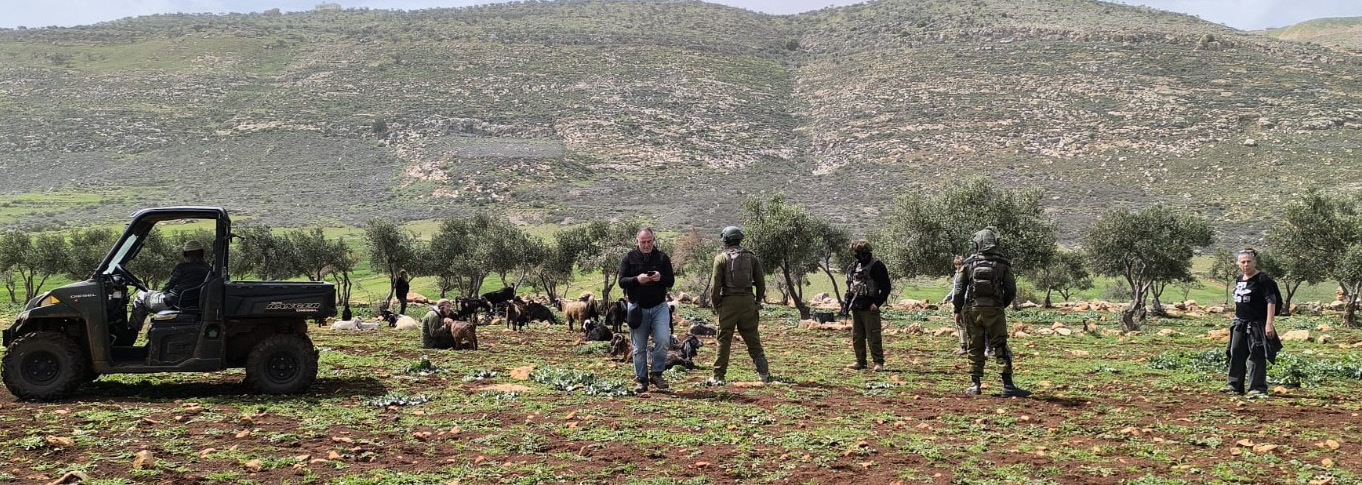
At around 11 p.m., three members of the Tubasi family were escorted to their homes in order to implement a High Court of Justice ruling requiring the state to secure their return. The police allowed only the father, mother and one of their sons to enter. The immediate family traveled in their own car, accompanied by three police vehicles.
But the mission encountered resistance from hundreds, perhaps even a thousand, settlers. This was no handful of people, and not 60 or 90. They arrived from across the Samaria region. It was a planned and coordinated operation: the electricity supply to the house had been cut in advance, while roadblocks made of rocks and earth had been placed around it.
As family members entered one of the two houses, they were attacked. The settlers set the family's car on fire, punctured the tires of the police vehicles and broke into the house. Border Police officers protected the family and attempted to evacuate them. The police vehicle into which they were placed came under a barrage of stones. They were then transferred to an armored vehicle and, under a hail of rocks, evacuated to Qusra, the neighboring Palestinian village.
Army forces attempting to reach Jalud encountered earth and stone barriers placed by tractors, preventing them from advancing. Soldiers reached the attacked homes on foot and secured the family's evacuation. After the family had left, both houses were set on fire despite the presence of soldiers. The fires burned for hours because firefighting vehicles could not reach the area, which had been blocked by the settlers.
At the same time, settlers attacked the village of Jalud, where they were stopped by local young residents. Another group of settlers attacked the neighboring village of Qaryut. Street fighting also broke out there, and several Palestinians were injured and evacuated to hospital. Some security forces were diverted to Qaryut in an effort to stop the attack.
By the end of the night, the settlers' operation had succeeded, while the security forces had failed to carry out the High Court's ruling. This significant episode offers a glimpse of what can be expected while the "settler lawbreakers" will oppose a new government.
In plain terms: if uniformed personnel actually carry out the orders of those responsible for maintaining law and security, this could become a civil war.
The opposition's proposed "reconstruction" leaves out the occupation
Two days earlier, opposition leaders Gadi Eisenkot, Naftali Bennett, Yair Golan and Avigdor Lieberman had met at Yair Lapid's home to formulate steps intended to strengthen cooperation among their parties ahead of the election.
In a statement they issued, they said: "The party leaders commit to working together immediately after the election to establish a government of reform and reconstruction."
To implement that commitment, they agreed to establish joint working groups within 48 hours. One would organize preparations for election day and deal with safeguarding the integrity of the elections. Another would formulate the basic principles for the next government, including equal sharing of the national burden, a state commission of inquiry into the October 7 massacre, term limits for the prime minister, a constitution, and an action plan for the government's first 100 days. A third group would focus on communications, combating fake news and smear campaigns.
There is not a single word about the occupation in the proposed principles.
At the same time, three of the four leaders have said they would veto the participation of Arab parties in the future government. So what kind of "reform and reconstruction" are they offering?
The Lapid-Bennett "change government" also took steps to improve and reform civilian areas—education, transportation, the environment and the police—but it did not address the fundamental problem. Neither in relation to the settlers nor in relation to the Palestinian Authority.
It appears that a government led by Eisenkot—if such a government is formed—would continue to "manage the conflict," while the settlers and those who send them would continue to operate without restraint.
For Looking the Occupation in the Eye, another active term lies ahead.