According to a B’Tselem report published at the beginning of the week, since October 7, 2023, and through June of this year, Israelis have shot and killed 1,086 Palestinians, including 241 children and teenagers. Of the total, at least 35 Palestinians were killed directly by settler gunfire. Few of these cases were investigated, no one was indicted, and no one is behind bars. Only a handful of those who opened fire, most of them in uniform, were actually in “mortal danger.” Yet, as it turns out, this is a winning argument.
Last week, a settler was sentenced to six months in prison after being convicted of assaulting a Palestinian teaching staff and activists from Looking the Occupation in the Eye in Ma`arajat two years ago. “The question is what happened that, in this particular case, the court convicted the defendants and even imposed a prison sentence,” asked Daniel De-Malach, one of those assaulted, in a post he published. This was his answer: “In addition to Palestinians, we activists providing protective presence were also attacked. That is, of course, a critical difference. It is not only that the court treats attacks on Israeli civilians differently from attacks on Palestinian residents. It is also important because when protective-presence activists are attacked, the perpetrators cannot use the argument with which they consistently evade punishment: ‘I felt that my life was in danger.’ One can assume that the trial would never have taken place had the victims been Palestinians alone. In that case, the prosecution would probably have refrained from filing charges in the first place, knowing that there was little chance of a conviction.”
According to B’Tselem’s report, titled The Erasure Project – Israel’s Dismantling of Palestinian Life in the West Bank, since the current government came to power at the end of 2022, and even more so since October 2023, Israel has intensified its assault on every aspect of Palestinian life in the West Bank. Palestinians are exposed to violence by soldiers and armed settlers, to arrest, abuse and even killing.
This week extreme propaganda campaign was launched against the creators of the film NAZA, who interviewed 24 anonymous soldiers and exposed alleged war crimes in Gaza—crimes the state preferred to conceal. By contrast, it can be said with certainty that Israel’s crimes in the West Bank are being committed in broad daylight.
A month has now passed since the operation to evacuate the outposts established in Area B between the villages of Qusra and Jalud began, yet settlers continue to move freely throughout an area that has been declared a closed military zone. The affair began with settlers invading Palestinian homes in Qusra, an invasion that was unusually condemned even by our allies in the United States. This week, Supreme Court justices sharply criticized the authorities during a hearing dealing with the events in Qusra.
The B’Tselem report, too, immediately received an appropriate Zionist response. “An explanatory terror attack: B’Tselem’s lies echoed in leading media outlets around the world” was the headline in Makor Rishon' the right wing and settlers daily newspaper. Israel in 2026 is not concerned with what happens, but with how it looks. The public ignores what is happening in the West Bank or Gaza and wakes up only when the events are exposed. Unsurprisingly, the anger is directed at those sounding the alarm.
The government lends its support to ethnic cleansing and the killing of civilians. Kahanist followers of Ben-Gvir, the Home Security minister' operating with little apparent restraint, threaten to “deal with” the “traitors” who have brought Israel’s disgrace to light. Meanwhile, the country’s self-described liberal public remains largely silent. To its shame, even the opposition leaders bury their heads in the sand.
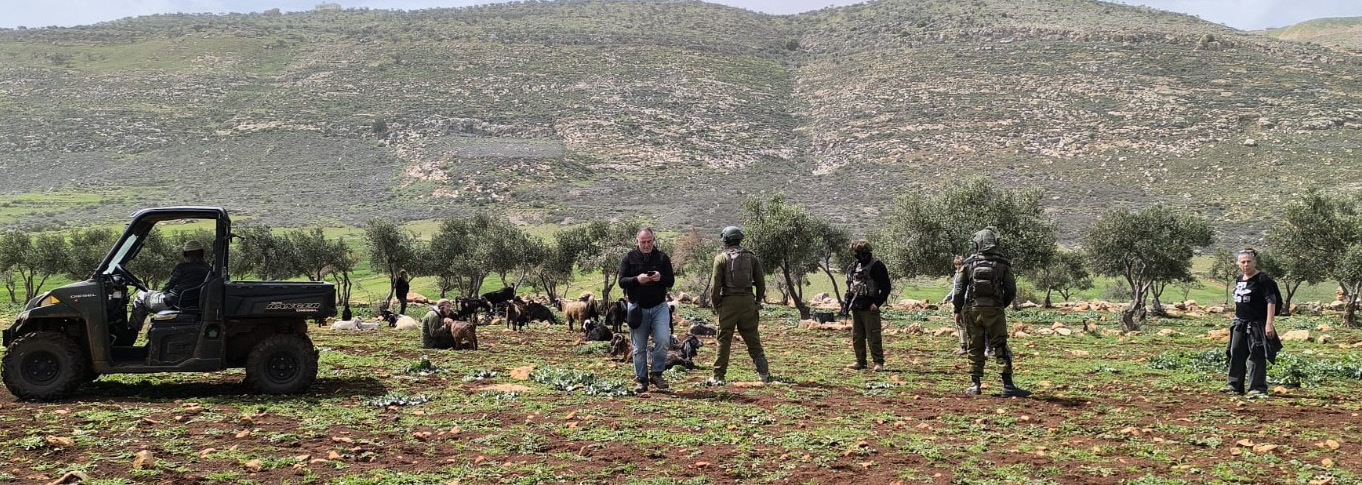
Khirbet a-Tawil this week - The Civil Administration’s Coordination and Liaison Office had still not responded to the residents’ request to coordinate repairs to the water-supply system, which was cut off several weeks ago following sabotage of the pipes. The disruption was accompanied by the pumping of water from wells located in residents’ yards by the owner of a nearby farm, Noam Jackson, and teenagers accompanying him.
The neighboring outpost hosted settlers for the holiday. Some of them joined incursions into the Palestinian residents’ olive groves and grazing lands. The presence of activists from Looking the Occupation in the Eye caused them to leave quickly.
Sunday – A soldier on leave was arrested after firing on Saturday toward the village of al-Mughayyir, north of Ramallah. The army reported that stones had been thrown on the outskirts of the village at an off-duty soldier, who opened fire in response. He was one of three settlers in civilian clothing who were at the scene.
Monday – B’Tselem published a comprehensive report on the West Bank. The report describes an Israeli project aimed at erasing the Palestinian collective and establishing permanent and continuous Jewish-Israeli control over the area. According to the report, the project began with the establishment of the current Netanyahu government at the end of 2022 and entered a new phase on October 7, 2023. Mechanisms that have existed for decades are now being deployed more rapidly and on a broader scale; political and legal constraints have been removed; and the violence employed directly by the state through its forces, and indirectly through settlers, has become more blatant and extreme than ever.
Tuesday – Settlers set fire to homes in the village of a-Tuwani in the southern Hebron Hills.
Wednesday – During a Supreme Court hearing concerning settlers’ takeover of Palestinian homes in the village of Qusra, the justices sharply criticized the authorities over the failure to enforce the law in the West Bank. Justice Ofer Grosskopf asked the state’s representatives: “Why are they being allowed to be there?” Justice Khaled Kabub said: “Ninety-five percent of the complaints are closed. I’m not sure enforcement is effective. When you see pictures of soldiers and settlers praying together, a place where everyone spends time together—how does that fit with the desire to protect the local population? When an offender boasts about breaking windows and causing incalculable damage, what kind of enforcement is that? Where is the enforcement in this case?”
Justice Grosskopf told the police representative: “The feeling is that this is a revolving door…. The moment there is a closure order, anyone who is there is committing an offense. When you catch someone who is there for the second time, what is the problem? Why isn’t an indictment filed? If someone is arrested for the second time, what more do you need?” The police representative replied that “there is no such thing as catching someone for the second time without an indictment being filed.” In response, Justice Kabub said: “That doesn’t square with the data,” while Justice Grosskopf added: “It’s the same people all the time.”
The Civil Administration demolished dozens of Palestinian structures and agricultural areas near two new settlements. Structures were demolished near the Shira settlement, west of Ariel, where a shepherding community had been living. Structures were also demolished near the Makeda settlement in the southern Hebron Hills. Smotrich’s party issued a statement saying that the demolitions were intended to remove “threats to the new communities.”
Thursday – Masked settlers attacked the Palestinian village of Burqa. The attackers set fire to agricultural land on the outskirts of the village, near residential homes. Video filmed at the scene showed an armed settler pointing a handgun toward the village’s homes. The police said they had arrested an Israeli suspected of involvement in an “arson and assault incident.” Another video showed a masked settler near a fire that had just been set and was beginning to spread. Two new outposts have recently been established near Burqa. According to a report in Haaretz, this was the third attack on the village.
Settlers also attacked Palestinian residents in their homes in Taybeh. The settlers threw rocks and assaulted human-rights activists.
Friday – Palestinians who arrived to harvest their privately owned vineyards, accompanied by activists from the "Bney Avraham", were detained by settlers. According to the activists, they had managed to continue harvesting until armed settlers arrived, accompanied by soldiers, who detained and handcuffed two Palestinians. A short while later, they were released and managed to leave with the grapes they had harvested.