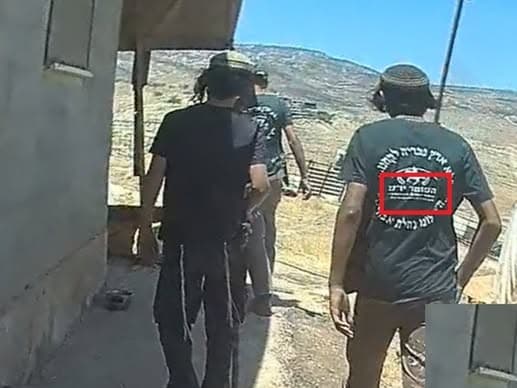



Images of the settler-terrorists riding on white pickup trucks on the Sabbath, on their way to carry out their rampage in Qusra, are being broadcast around the world. By now, nothing can be hidden, to the point that an IDF spokesperson has referred to them as “rioters.” Yet opposition spokespeople continue to look the other way, lamenting what they call the IDF’s “diversion from its primary mission,” in the words of Gadi Eisenkot.
But the people’s army stationed in the West Bank has become the army of the settlers of the so-called State of Judea. The soldiers deployed in Qusra and the neighboring village of Jalud, both in Area B, do not lift a finger against settlers roaming through these villages and threatening their residents—even though an order declaring the area a closed military zone to Israelis has been issued. The order, however, is not enforced against settlers.
The rampage by MK Zvi Sukkot with his hammer is another expression of the systematic violence employed by settlers, violence the army permits and, in other cases, even assists in pursuing the dream of ethnic cleansing. MK Sukkot’s display of force took place under military escort, and it is far from the only form of support the army provides to settlers.
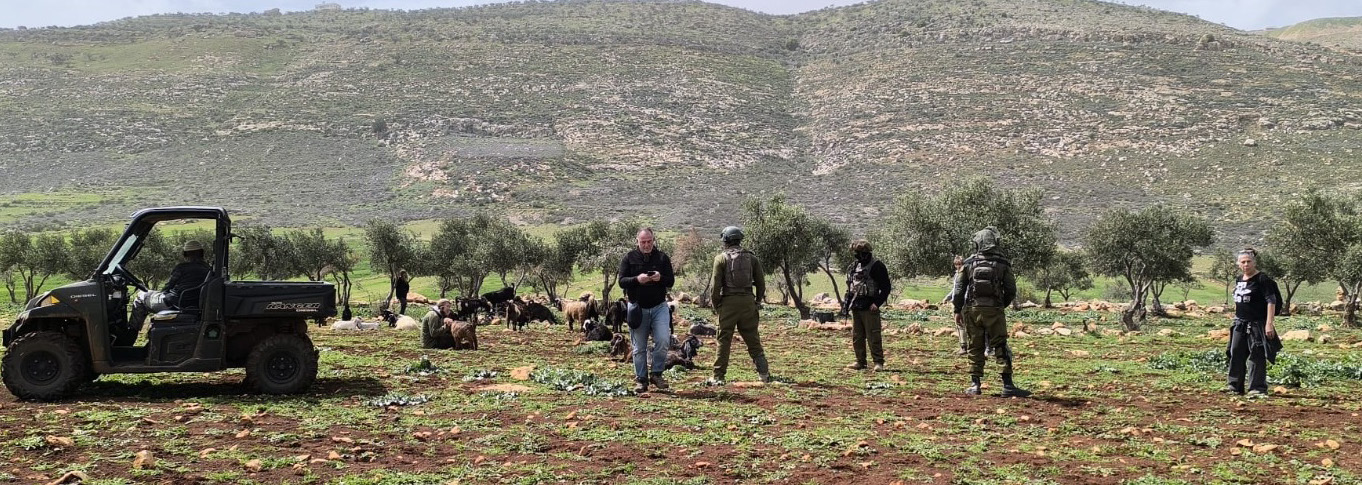
Orders declaring areas closed military zones are issued every day throughout the West Bank. Their purpose is to remove human rights activists who maintain a protective presence, while settlers are allowed to remain in the area. With state support, settlers are working to drive shepherding communities from their land. In the midst of summer, they are doing so by depriving Palestinian communities of their water.
This week as well, settlers from the Jackson outpost continued pumping water from the wells belonging to residents of Khirbet al-Tawil, where activists from Looking the Occupation in the Eye maintain a protective presence. A closed military zone order was issued for the village as early as Sunday. Yet throughout the week, settlers were allowed to remain inside the closed zone, while the activists were expelled under threats of arrest.
See the report by Looking the Occupation in the Eye activist Daniel De-Malach, attached to this review.
Sunday – A 14-year-old Palestinian boy, Islam Ajjouri, was killed by gunfire from Israeli forces in Askar refugee camp, east of Nablus. In the morning, security forces raided buildings on the camp’s main street and in nearby alleys. As the forces withdrew, gunfire was heard.
Also in the northern West Bank: soldiers raised an Israeli flag over the minaret of a mosque in Nur Shams refugee camp.
Khirbet al-Tawil – under army protection: Settler Noam Jackson pumped the contents of a Palestinian water well. Jackson’s son attacked an activist who tried to protect the well, pushing her and knocking her down a large stone step. A complaint was filed over the assault.
Home Front Command soldiers removed the activists from the area. When the activists explained that their presence was essential to prevent the theft of the water, they were told that the soldiers would remain and prevent the theft. Yet immediately after the activists were removed, the soldiers allowed the settler to empty the well.
A vehicle, a residential structure, and another wooden structure in the village of Osarin, south of Nablus, were set on fire by settlers overnight between Saturday and Sunday. Settlers also torched Palestinian property, including a tent, in Burqa, in the Nablus area.
Two settlers, aged 16 and 17, residents of Abigail in the southern Hebron Hills and of Jerusalem, were arrested. The 16-year-old is suspected of beating Said al-Amour of Khirbet al-Rakeez, a 70-year-old man who lost a leg after being shot by a settler; the 17-year-old filmed the assault. The video was circulated online.
Monday – Young settlers from Noam Jackson’s farm arrived in order to pump water from the well in Khirbet al-Tawil. Activists from Looking the Occupation in the Eye prevented them from doing so in a struggle involving pushing and kicking. Soldiers arrived at the scene and presented a closed military zone order that applied to everyone present. While the Looking the Occupation in the Eye activists withdrew and the army traced them, the settlers returned to the area and pumped the water from the well. The soldiers detained the activists with the aim of having the police arrest them, while the settlers who had been filmed pumping the water left the area. The police officer told the activists to leave the area and refused to comply with a military officer who tried to persuade him to make arrests.
Settlers set fire to an aluminum factory in the village of Ein Sinia, north of Ramallah.
Tuesday – The IDF presents: Monument demolition. MK Zvi Sukkot, together with other settlers, smashed a monument located in the village of Madama, south of Nablus, not far from Yitzhar, where Sukkot lives. The act was carried out under the protection of soldiers.
Sukkot said that the monument commemorated terrorists who had murdered Israelis and that he had acted in coordination with the IDF. The army responded that Sukkot and his team had “acted deceitfully and manipulatively, without authority and in complete violation of the approved framework.”
Settlers attacked left-wing activists and journalists with clubs, stones and pepper spray in the village of Jannata in the Bethlehem Governorate. Several activists were injured, one of them in the head. Soldiers who were present did nothing, and no one was arrested. In addition, the settlers smashed windows and punctured the tires of four vehicles belonging to activists from Standing Together, Rabbis for Human Rights and Bnei Avraham, as well as vehicles belonging to media crews.
Soldiers attempted to prevent MK Ofer Cassif (Hadash) from visiting Palestinian families in Qusra. One soldier pretended that the MK had assaulted him, while another pushed Cassif violently.
Settlers destroyed the homes of the Shakara Bedouin community, which had been expelled from the Nablus area. The IDF uprooted more than 100 ancient olive trees in Bartaa.
Wednesday – Nikolay Mladenov, director-general of the Council for Peace and Settlement in the Gaza Strip: “Hamas and the armed groups in Gaza have announced for the first time their agreement to surrender their weapons and transfer security and civilian powers to an interim administration recognized by the United Nations.”
A Palestinian family was expelled from its home under an order issued against a nearby outpost. Police claimed it was a human error. The incident occurred in a village near Bethlehem whose residents suffer from settler violence, particularly from a nearby outpost. The regional commander issued an order to evacuate the outpost, but police instead ordered the Palestinian family to leave its own property. “I decide whom I evacuate first,” the police officer at the scene said.
Friday – A Palestinian shepherd was wounded by gunfire and two others were beaten by settlers in the village of al-Mughayyir, north of Ramallah. Settlers grazed their sheep within the village, attempted to enter one of the homes, clashed with residents and tried to steal herds of sheep. An IDF force arrived in the village, threw stun grenades and beat a woman. According to a report by the Red Crescent, settlers and uniformed personnel delayed the arrival of emergency medical teams.
Saturday – Dozens of masked settlers attacked Palestinian workers who were working in a building in the village of Qusra and threw stones at the building. An IDF force arrived after the attack. The army subsequently announced that dozens of “Israeli rioters,” as the statement put it, had barricaded themselves inside the building in Qusra and injured several Palestinians. The IDF detained Palestinians who had been in the house that was attacked and released them several kilometers away. No arrests of settlers were reported.
In the nearby village of Jalud, settlers attacked an NBC news crew, all of whose members were foreign nationals, after they interviewed a Palestinian family living there. The settlers injured the husband and wife as well as the journalists, all of whom required medical treatment.
A British human rights activist was detained and forcibly dragged away from Umm al-Khair by armed settlers from the Carmel settlement in the southern Hebron Hills. The activist was arrested by police.
Settlers were active in other locations throughout the West Bank, as they are every Saturday. Haaretz reported that in Silwad, northeast of Ramallah, two women were attacked in agricultural land. Residents of Sinjil confronted a settler who tried to approach a sheep pen, as well as IDF forces that arrived afterward.
Near the Tekoa settlement, settlers threw stones at vehicles and injured one person. In the village of Hussan, settlers attacked a father and his son in agricultural land, among other things with rifle butts. There were also reports of property destruction and damage to crops in the Masafer Yatta and Hebron areas, as well as near Jenin.
Document
The Army and the Settlers Are Working Together to Drive Out the Khirbet al-Tawil Community
By Daniel De-Malach
The army’s cooperation with the settlers who are stealing Palestinian water in Khirbet al-Tawil, near Aqraba, in an effort to drive the residents from their homes is escalating.
This is no longer a case of turning a blind eye. It is active cooperation directed against us, the activists maintaining a protective presence, while misleading the police.
For quite some time now, the army has been making manipulative and selective use of closed military zone orders to keep us away and allow settlers to harass the residents of al-Tawil freely. But this week they took it one step further.
A reminder: last week, activist Doron Meinraht was arrested while protecting a water well located on privately owned Palestinian land from settlers stealing its water. In response, the District Court ordered his release and expressed concern over the improper use of the closed military zone order.
On Monday, when I was there with my colleagues on “watch,” the army’s response came. Soldiers attempted to deceive the police into arresting us near that very same well. It partially worked, as I will explain below.
Here is the story in somewhat greater detail, for anyone who is genuinely interested:
1. In recent months, the settlers have repeatedly disconnected the water pipe supplying the village. As a result, the water reserves in the wells used by the Palestinian herders for their livestock are steadily dwindling.
2. On Monday, the settlers—Noam Jackson, his family and several accompanying children—arrived at the water well with a herd of cows and attempted to pump the water.
3. We blocked access to the well, prevented the theft and called the police.
4. Jackson called the army and spoke “with the company commander.”
5. The army arrived. The soldiers were masked. They declared the area a closed military zone and ostensibly told not only us to leave, but the settlers as well.
6. The settlers moved away, and so did we.
7. Despite the fact that we had left, the soldiers continued tracing the activists. They stayed close to one vehicle even after it entered the Trans-Samaria Highway toward the settlement of Migdalim. They remained alongside it even when it stopped.
8. A civilian vehicle, apparently belonging to settlers, followed another activists’ car. It stopped next to us and asked, “Is Doron with you?”
9. After the soldiers made sure that we had moved away, the settlers returned to the well and managed to pump water from it before we returned.
10. We reached the well, but with the pipe deep underground and their pump already operating, there was not much we could do.
11. The army returned to the well. The settlers left just as the soldiers approached, and the soldiers announced that we were being detained because we had allegedly violated the order they had given us several hours earlier. They waited for the police.
12. After an hour, Noam Jackson arrived to see what was happening. The soldiers, of course, did not detain him, and he left.
13. The soldiers repeatedly called Border Police, asking them to arrest us.
14. When the police arrived several hours later, the army presented a distorted version of events, as though only we had violated the order. They did not mention the settlers or the water that had been stolen.
15. After hearing our account, the police did not accept the argument that we should be arrested and demanded only that we leave the area.
16. The soldiers called the person they referred to as “the officer responsible for the sector” and asked him to persuade the police to arrest us anyway.
17. The attempt to have us arrested failed. The police officer was not persuaded, and we left. But in the meantime, of course, the water had been stolen.
What happens next remains unknown. In the face of the cooperation between the settlers and the army, it is unclear whether the Palestinians will be able to bring additional water to replace what was taken from them and make it through the summer in the village with their herds.
In the meantime, their restraint in the face of the settlers—a restraint without which they would have been driven out long ago—is admirable, especially because it is accompanied by their determination to remain on their land.