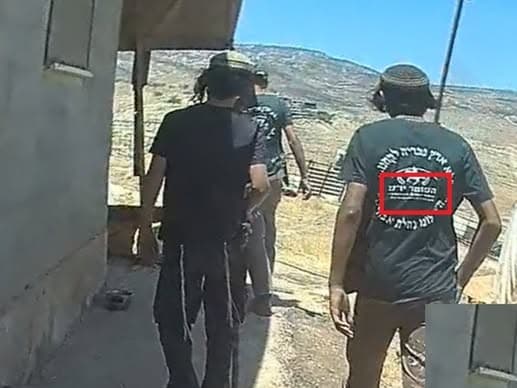



The unusually extensive media coverage of what happened in Kusra has not changed the situation on the ground: even after two weeks, settlers are still moving around near the two besieged homes, while the army’s elite units make no effort to remove them, even though the area has been declared a closed military zone. By contrast, the order is enforced against Israeli and foreign human rights activists and journalists—those who are not settlers.
What is happening in Kusra is taking place in other parts of the West Bank as well, in accordance with the policy of the Smotrich-Netanyahu government. In Khirbet a-Tawil, Doron Meinert, one of the leaders of Looking the Occupation in the Eye, was arrested, allegedly for violating a similar order while attempting to prevent settlers from stealing water from a Palestinian cistern. The District Court rejected the police’s claims, released him, and expressed astonishment that the order was enforced only against him and not against the settlers.
During the week, the army issued four closed military zone orders covering the Khirbet a-Tawil area. In each case, the order applied only to activists from Looking the Occupation in the Eye and was not enforced against the settlers, who continued moving around the community. Minors from the outpost established under the auspices of Jackson’s Farm entered the Khirbet a-Tawil residential compound during the week, harassed its residents, sprayed pepper spray and spat at Looking the Occupation in the Eye activists.
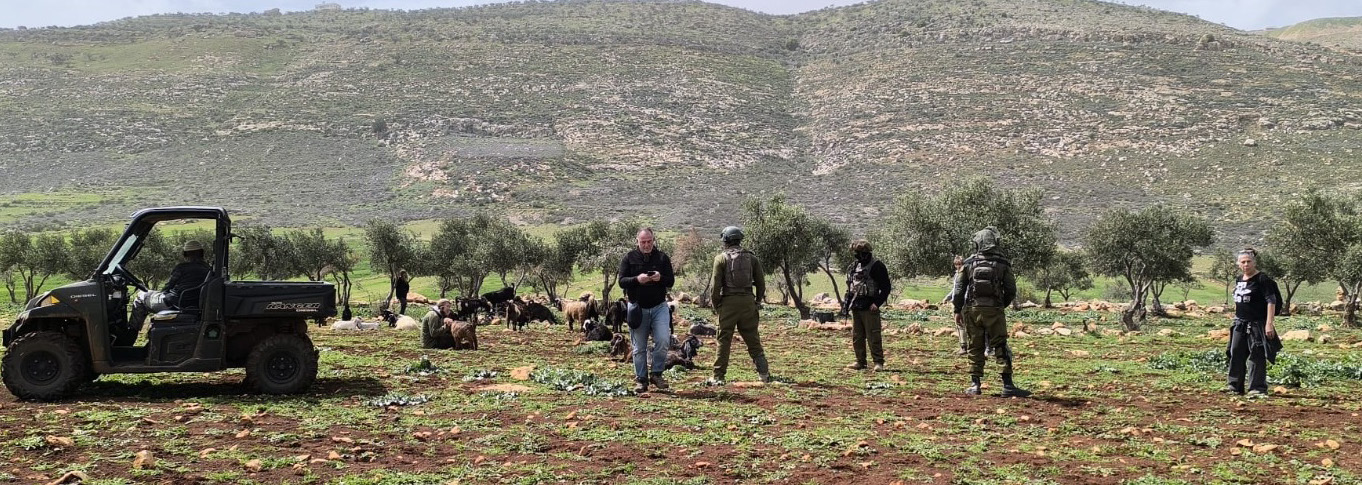
This week, an unusual indictment was filed against a settler who had used violence against the same community in Khirbet a-Tawil, which has been under attack by settlers from Jackson’s Farm. But apparently Netanyahu is not content merely to heat up the West Bank. Tom Barrack, the U.S. ambassador to Turkey and President Trump’s envoy to Syria, said in an interview that Israel’s attack on the Abu al-Duhur base in Syria could have led to a direct military confrontation between Israel and Turkey, and that this may in fact have been Israel’s objective.
Sunday – Settlers are still staying on Mount Ein Ania near Nablus in the West Bank, where the Palestinian villages of Kusra and Jalud are located. This remains the case even after the outpost that settlers had established in the courtyard of the house in Kusra was dismantled. As part of the military operation to evacuate illegal outposts, IDF forces are stationed there, but they are not removing the settlers even though the area has been declared a closed military zone. By contrast, the IDF strictly enforces the closure order against every civilian who arrives to help the residents. The closed military zone order was also imposed on local residents, and workers at a nearby factory were sent home.
Settlers attacked a dentist from East Jerusalem and his son in Beit Sahour near Bethlehem. The dentist, Dr. Majed Alian, drove in the afternoon to land he owns in the West Bank after hearing that settlers had established an outpost nearby, cut down olive trees and destroyed a fence. “As soon as they arrived at the site, two settlers appeared, sprayed them with pepper spray and began beating them,” said Mohammad Alian, the dentist’s brother. “When they tried to push them away, another ten masked settlers armed with clubs arrived and attacked them brutally.” The brother said that during the attack, the father and son tried to escape, and the settlers pursued them in off-road vehicles. He said they also vandalized the Palestinians’ car. He added that when he arrived to help them, he too was attacked. “One of the settlers, riding a horse, tried to hit me with a club, but I managed to escape.” According to him, the police arrived about an hour later. The officers documented the damage to the vehicle but did not attempt to arrest the attackers.
Two Palestinians from Hebron were wounded by gunfire and eight others were beaten in the al-Jaabari neighborhood during clashes with settlers and soldiers. Two Israeli civilians were injured in the incident by stone throwing.
Settlers attacked Palestinian residents in the village of Beit Einun in the Hebron district. The army detained 12 Palestinians who were involved in the incident for questioning.
Monday – The siege of the homes in Kusra was not lifted, and settlers continued to move around the area alongside the uniformed personnel stationed there. One of the Palestinian homeowners, who holds American citizenship, came from the United States, and the IDF allowed him to enter the house accompanied by journalists. In the evening, he raised the American flag above the building.
Masafer Yatta, southern Hebron Hills: The IDF demolished homes, agricultural structures and water sources in the communities of al-Fakheit and al-Tawamin. Families were left without shelter in the height of summer.
Tuesday – There Is a Judge in Lod
Home Front Command soldiers provided security for Noam Jackson, the settler from Jackson’s Farm, as he broke into a Palestinian water cistern in Khirbet a-Tawil and pumped water from it in full view of soldiers. Looking the Occupation in the Eye activists had been removed from the area under a closed military zone order issued by the commander of the Samaria Brigade.
Jackson and youths staying at the farm, some of them his children, harass the Palestinian community in Khirbet a-Tawil, on the outskirts of Aqraba, on a daily basis. In recent weeks, the community has suffered a severe water shortage after settlers vandalized the pipeline supplying water to the community, while the army has prevented it from being repaired. Residents depend on water that they collect and store in underground cisterns.
After the lock on the water cistern was broken in the morning, the residents installed a new lock. Jackson and minors accompanied by a Home Front Command force then arrived. He broke the lock, used the water to water his flock of sheep and took the cistern’s cover with him. Colonel (res.) Doron Meinert, one of the leaders of Looking the Occupation in the Eye, was present and protested the theft. He was taken to the Ariel police station, allegedly for violating a closed military zone order, while the settlers were allowed to remain at the site. At the Ariel police station, officers demanded that he sign a restriction order as a condition for his release. Meinert refused and was detained until he could be brought before a judge.
After spending a night in detention, a hearing was held the following day at the Petah Tikva Magistrate’s Court before Judge Ariel Salto. The police requested a 15-day restraining order barring Doron Meinert from entering within a one-kilometer radius of the Khirbet a-Tawil area. His attorney argued that the arrest had taken place after the order had expired, that Meinert had been outside the area marked in the order, and that the enforcement had been selective. The police prosecutor insisted that Meinert had been within the designated time and area. The judge noted that, according to the documents before him, the soldier’s instruction to leave the area had been issued while the order was still in effect. He therefore ruled that there was reasonable suspicion that an offense had been committed and, noting that the suspect had no criminal record, imposed a ten-day exclusion order.
Doron Meinert appealed to the Central District Court. At a hearing on Thursday, Judge Michal Barak-Nevo accepted the argument of his attorney, Alon Sapir, that the appellant had been outside the area marked in the order and that there was therefore no evidentiary basis for the suspicion alleged by the state. The exclusion order imposed by the Magistrate’s Court was consequently cancelled. In addition, the judge expressed astonishment as to why the settlers who were present at the site had not been detained or arrested. In plain terms: selective enforcement.
Protective-presence activists from Rabbis for Human Rights, Bnei Avraham and the Standing Together Solidarity Guard attempted to reach Palestinian homes suffering from settler terror originating from the Kochav Yehuda outpost. Soldiers detained them on the grounds that the area of the homes and outpost was a closed military zone—but allowed settlers to remain there and attempt to drive the activists away by force.
IDF forces operated in the town of Qabatiya, south of Jenin, raiding dozens of homes and buildings and carrying out searches and arrests. Palestinian youths detained for questioning were released with numbers written in marker on their foreheads or bodies. The IDF responded: “The commanders made clear to the forces the severity of the incident, and lessons have been learned.”
Kati Bar of Mothers Against Violence reported on what was happening in Umm al-Khair in the southern Hebron Hills. According to her account, settler Shimon Atiya, against whom an exclusion order had been issued during the past year, again entered the courtyards of Palestinian families. Women were attacked and injured. Security forces were called, and a police officer who arrived chose to warn the Palestinian resident who was defending himself that if he touched the intruder, he would be arrested on suspicion of assault.
Wednesday – Kusra: Ten days after settlers imposed a siege on two Palestinian homes, the IDF is preventing the Palestinians from leaving their houses while the settlers continue to move around the area. According to the homeowners and their attorney, Roni Peli of Yesh Din, anyone inside the homes must coordinate with the IDF in order to leave, even to go into the yard. Other residents of the village also report that they were told not to leave their homes.
Thursday – The State Attorney’s Office filed an indictment against Yedidya Kaufman, 21, from Beitar Illit. The defendant was documented about three months ago running over a flock of sheep belonging to Palestinian residents in Khirbet a-Tawil with a Ranger vehicle, where Looking the Occupation in the Eye activists maintain a protective presence. When the flock’s owner confronted him, Kaufman attacked him and ran over additional sheep.
During April and May of this year, Kaufman stayed at Jackson’s Farm and grazed flocks belonging to Noam Jackson near the Palestinian community. In one of the incidents described in the indictment, he entered a residential compound in Khirbet a-Tawil together with other settlers, carrying sticks in order to intimidate the residents. A woman was beaten. In another incident, the indictment describes how he entered a home courtyard in a Ranger vehicle, claiming that he was searching for missing sheep. One of the Looking the Occupation in the Eye activists who attempted to block Kaufman was attacked by him. He was caught driving without a license a month and a half after an arrest warrant had been issued against him.
The families under siege in Kusra asked the army for permission to bring clothing for the women and girls in the besieged homes. At the same time, soldiers were filmed throwing clothes and belongings from a window of one of the houses they have occupied for about a week. Yesh Din: “The footage shows that instead of protecting the families, the army is abusing them. After failing to enforce the law against the settlers, the army has now imposed a week-long siege on the families in two homes, preventing them from leaving, receiving food supplies or obtaining basic necessities—even though they are not suspected of any wrongdoing.”
Six Palestinians were injured when settlers attacked Palestinian vehicles traveling on the road connecting the villages of Abu Falah and al-Mughayyir in the Ramallah area.
Border Police forces evacuated an outpost called “Shepherds’ Village” in the village of Deir Istiya, in Area B. Four settlers were arrested after throwing stones at Border Police officers.
Friday – “Go to Pennsylvania”
“Residents of al-Maniya, who live near the settlement of Tekoa in eastern Gush Etzion, have been suffering for many months from severe violence coming from the illegal Magen Avraham outpost,” wrote Ariel Schwartz of Bnei Avraham in a post. The outpost was established near the village homes, and the familiar pattern was put into practice: cutting electricity cables, destroying water pipes and harassing anyone who comes to repair them, damaging olive trees, blocking access roads, issuing threats, and stealing goats and sheep. Activists from Bnei Avraham arrived to maintain a protective presence. The settlers called the security forces, who chose to order the immediate evacuation of the residents from their homes, together with the activists. The soldiers presented a “closed military zone” order whose heading read “Magen Avraham Outpost.” The order had been signed a year earlier and was intended to evacuate the illegal outpost. It was now being used to evacuate the activists.
According to the post, “The father of the family begged them to have mercy on him and not remove him from his home. He asked the police officer, ‘What am I supposed to do? Where am I supposed to go?’ But the officer simply answered him coldly, ‘As far as I’m concerned, Pennsylvania.’ They gave them ten minutes to pack their few belongings and whatever sheep remained and leave the house.” Inquiries with IDF officials were met with the response that the evacuation had not been authorized and had been carried out at the discretion of the forces on the ground.
A 17-year-old Palestinian boy was shot dead and a 70-year-old man was seriously wounded when settlers and residents of Beitar Illit “went for a walk” near the village of Sa’ir, located near Gush Etzion. Residents threw stones at the settlers, after which live fire was directed at them. Settlers established an outpost on a hill overlooking the village about three weeks ago, and last week a settler accompanied by a soldier fired toward Sa’ir and seriously wounded one of its residents.
Dozens of settlers from Susya and nearby outposts raided a Palestinian quarry in Wadi al-Rahim in the southern Hebron Hills. They burned several pieces of heavy machinery and sprayed graffiti. In Burqa, near Nablus, dozens of olive trees were set on fire.
Saturday – A demonstration was held in Habima Square in Tel Aviv. More than 100 people protested against the occupation. The protest in support of a state commission of inquiry was attended by only few hundreds. The public is exhausted.